
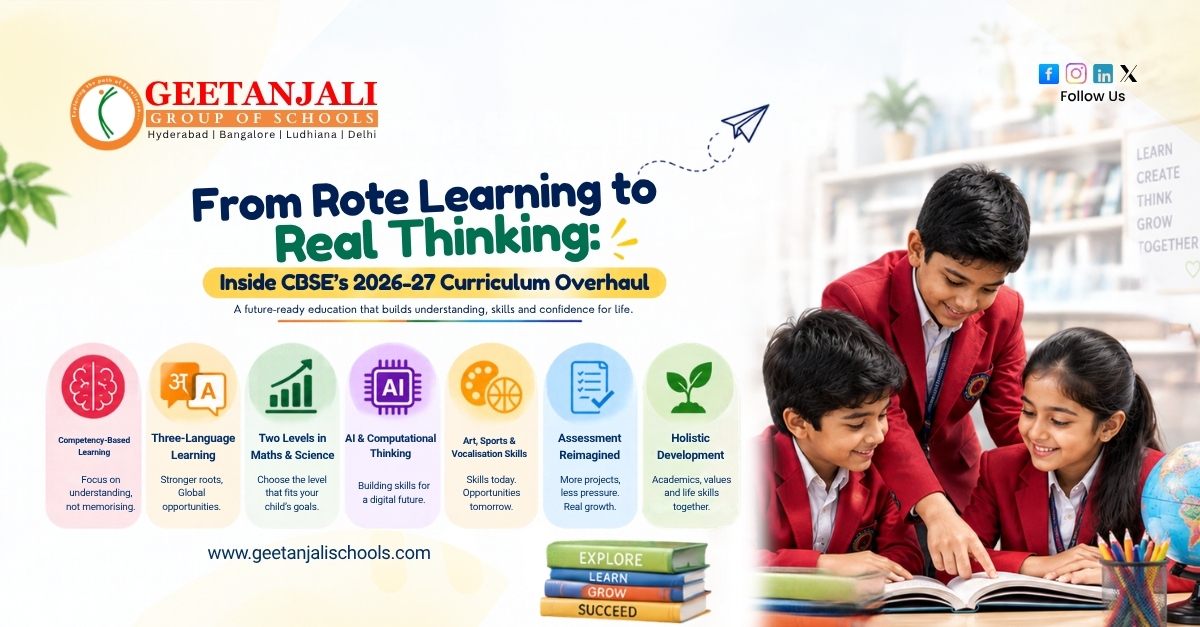
Indian school education is in one of its biggest changes in decades. The CBSE Curriculum 2026-27 has taken a significant step away from rote learning and towards a model that emphasizes comprehension, application, and practical skills. This change becomes even more significant when parents look for the best CBSE school in Hyderabad as the attitude of the school towards these changes will determine the preparedness of a child for the future. We see this change as a way forward and not a hurdle when introducing change at Geetanjali Group of Schools, a change we have always believed in Learning that makes sense, not memorised learning.
But why did CBSE decide it was time for change?
The new curriculum is designed on the lines of the National Education Policy (NEP) 2020 and National Curriculum Framework for School Education 2023 (NCFSE). In Indian classrooms, students have been rewarded for memorizing facts during exams, and have not been adequately encouraged to think creatively or solve problems.Indian classrooms have for years focused on memorizing facts during exams, while neglecting reasoning, creativity, and problem solving. That is the structural answer of CBSE 2026-27 overhaul, which starts from Classes 9-12 and continues down the AI and Computational Thinking curriculum up to Classes 3-8.
But why did CBSE decide it was time for change?
The most notable change in academics is the two level system in Mathematics and Science from Class 9 onwards. Students will no longer be forced to follow a single track, one-size-fits-all path, but will instead have the option to follow a course of study built to their speed and career goals. This will enable a future engineer and a future designer to both excel, neither to be overlooked, nor to be under-schooled. There is a strong statement here that all children learn differently, but it is quietly made.
A New Language Policy for a Multilingual Mind
The three language formula now takes shape, a third language being compulsory from class 6 and at least two of the three languages being Indian languages. Contrary to popular belief, studies have consistently found that multilingual learners have more flexible thinking and enhanced communication skills. It also brings the students back into the fold of the rich linguistic heritage of India, without ever losing the grip of English as a language of instruction and communication.
AI, Vocational Skills and Learning by Doing.
The introduction of Artificially Intelligent subjects from Class 3 and making vocational and practical subjects compulsory from Senior level seem to be the most future-oriented change. This is the latest statement from CBSE that mere knowledge of the book is not enough. Students must be given real-world experiences through coding, computational thinking, design, and applications, to prepare them for the reality of the world into which they will enter. Experiential learning, hands-on activities, field trips and project-based evaluation is becoming part of daily life in the classroom, not an add-on.
Examination for the Test of Thinking, Not Just Memory
There’s a quiet revolution in assessment going on. Competency based questions, two attempts at the class 10 board exam (with the higher mark being awarded), and increased emphasis on application and analysis are all aimed at lowering stress on exam day and encouraging true understanding. Progress cards are also developing to show more about the child: leadership, emotional intelligence and personality, as well as marks on a score card.
How is Geetanjali Group of Schools preparing students today?
Our academic staff have already started implementing the following changes in classrooms, internal assessments and skill modules in our school as per the new guidelines given by the CBSE. At a forward thinking CBSE school, Hyderabad we don’t believe in preparing for a deadline. Our teachers are continually being trained, and when these changes are in full effect, our students will not be just prepared, they will be prepared and ahead. Concept-based teaching, activity-driven classrooms, and a true curiosity-driven approach to learning is something that we’ve always done, and the new curriculum just reinforces our direction.
What This Means for Parents and Students
When a school system adjusts, it can feel heavy at first. Still, the goal is not confusing. The change is there to help students form their own thoughts. It also trains them to face new tasks without getting stuck. Lessons are meant to connect to life, not only to pages in a workbook. This is not only about doing well on one test.
If you are checking schools across the city, use that search wisely. Pick places that track progress over time. Do not choose only based on fast scores. At Geetanjali Group of Schools, the staff keeps improving the way lessons are delivered. They use newer classroom tools and they bring in trained teachers. The learning plan is shaped for each student as they move ahead.
Looking Ahead
The CBSE 2026-27 curriculum update is not just another list. It also affects how learning is judged. The aim is to make lessons easier to follow and more interesting to attend. Students should be able to link key ideas to what they already grasp. As schools start making this move in classrooms nationwide, starting early can help students settle in sooner.
That is our focus. We keep working each day. For every child who joins our campus.