
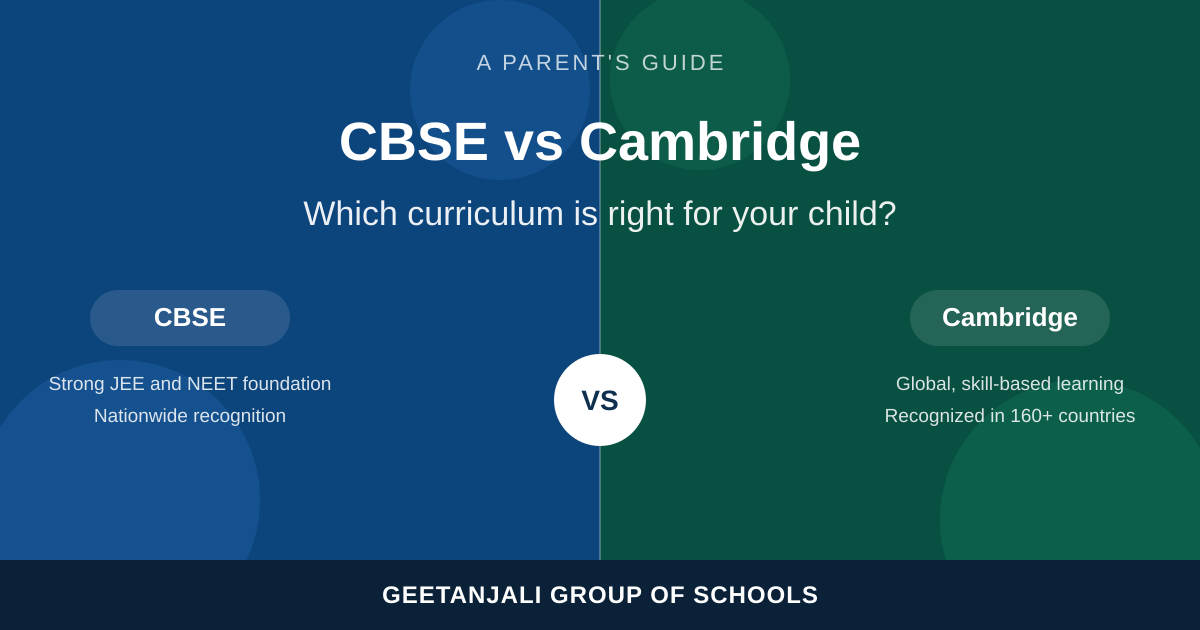
Choosing the right curriculum is one of the biggest decisions a parent makes and it’s also one of the most confusing. Should your child follow the CBSE curriculum, with its strong foundation for competitive exams like JEE and NEET? Or the Cambridge curriculum, known for its global outlook and skill-based learning?
There’s no single “better” answer, only the answer that’s better for your child. In this guide, we break down what CBSE and Cambridge actually mean in the classroom, how they differ, and how to decide which one fits your child’s learning style, interests, and future goals.
At Geetanjali Group of Schools, we’ve spent over two decades working with both systems, our Geetanjali Olympiad Schools follow the CBSE curriculum, our Geetanjali International Schools follow Cambridge, and National Premium School, Puppalaguda offers both under one roof. So this isn’t theory for us, it’s what we see in our classrooms every day.
What Is the CBSE Curriculum?
The Central Board of Secondary Education (CBSE) is India’s most widely followed school board. It’s structured, exam-oriented, and designed to build a strong base in Mathematics and Science, which is why it’s the preferred choice for families planning ahead for engineering and medical entrance exams like JEE and NEET.
Key features of CBSE:
- Uniform, NCERT-aligned syllabus recognized across India
- Strong emphasis on core subjects — Mathematics, Science, and Social Studies
- Well-defined board exams at Grade 10 and Grade 12
- Widely accepted for admissions to Indian universities and competitive exams
- A familiar, time-tested structure that many Indian parents grew up with themselves
At our Olympiad campuses, the CBSE syllabus is taught through an integrated, conceptual approach rather than rote memorization, so students build genuine problem-solving skills for JEE and NEET, without needing outside tuition.
What Is the Cambridge Curriculum?
The Cambridge International curriculum (from Cambridge Assessment International Education, UK) takes a different approach, it’s less about memorizing content and more about how a child thinks, questions, and applies knowledge. It’s followed by thousands of schools across more than 160 countries.
Key features of Cambridge:
- Skill-based learning — analysis, research, and application over memorization
- Flexible subject choices, especially at the IGCSE and A-Level stages
- Continuous assessment alongside external examinations
- Strong recognition for admissions to universities abroad (UK, US, Canada, Singapore, etc.)
- A global perspective built into the curriculum design
Because Cambridge is internationally benchmarked, it’s a natural fit for families who may relocate abroad, or who want their child’s qualification to be recognized by universities outside India.
CBSE vs Cambridge: The Key Differences
| Aspect | CBSE | Cambridge |
| Teaching style | Structured, syllabus-driven | Inquiry-based, skill-driven |
| Assessment | Primarily board exams (Grade 10 & 12) | Continuous assessment + external exams |
| Best suited for | Engineering/medical aspirants (JEE, NEET) | Global university aspirants, research-oriented learners |
| Recognition | Nationwide in India | Internationally, across 160+ countries |
| Flexibility of subjects | Fixed core subjects | Broader elective choices from IGCSE onward |
| Higher education pathway | Indian universities, competitive exams | Indian and international universities |
How to Decide: 5 Questions to Ask Yourself
- Where do you see your child studying after Grade 12- in India, or possibly abroad?
- Does your child thrive with structure and repetition, or with open-ended, exploratory learning?
- Are you already thinking about JEE or NEET preparation? CBSE’s foundation aligns closely with these exams.
- How important is international mobility, say, if your family may relocate for work?
- Does your child enjoy research, projects, and presentations, or prefer clearly defined problem sets?
There’s rarely a “wrong” choice here, both boards produce successful, well-rounded students. What matters is matching the curriculum to your child’s temperament and your family’s long-term plans.
You Don’t Have to Choose Blindly
One advantage of choosing a school group like Geetanjali is that you can talk to educators who work with both systems every day, rather than relying on a single school’s perspective.
- If you’re leaning towards a strong, exam-focused foundation, explore our Geetanjali Olympiad Schools (CBSE), with nine campuses across Hyderabad.
- If a global, skills-first approach appeals to you, explore our Geetanjali International Schools (Cambridge), with campuses in Hyderabad, Bangalore, Ludhiana, and Gurgaon.
- If you’d rather explore both curriculums under one campus before deciding, visit National Premium School, Puppalaguda, which offers CBSE, Cambridge, and A-Levels together.
Frequently Asked Questions
Is Cambridge curriculum harder than CBSE? Not harder — different. Cambridge assesses understanding and application over a longer period, while CBSE concentrates heavily on board-exam performance at Grade 10 and 12.
Can a student switch from CBSE to Cambridge later, or vice versa? Yes, though it’s easiest before Grade 9, since both systems build subject depth progressively from that point onward.
Which curriculum is better for JEE/NEET preparation? CBSE’s syllabus aligns most closely with JEE and NEET exam patterns, which is why our Olympiad Schools use an integrated CBSE approach specifically built for these aspirants.
Is Cambridge curriculum recognized in India? Yes. Cambridge qualifications are recognized by Indian universities and by the Association of Indian Universities (AIU), in addition to being accepted internationally.
Final Thoughts
CBSE and Cambridge aren’t rivals — they’re two well-respected paths to the same goal: helping your child build a strong, confident future. The right choice depends on your child’s learning style and where you picture their journey heading.
Still unsure? Get in touch with our admissions team — we’re happy to walk you through both curriculums, campus by campus, so you can make the choice with confidence.